Brake fluid — how often to change it, water test, DOT 3/4/5.1 and cost
Brake fluid absorbs water over time and loses its resistance to high temperature, even though it may look fine for years. We explain how often to change it, how to test the water content, which DOT to choose and what the change costs.
8 min read · Pulsecar team · updated:
Brake fluid change — the short answer
Most car manufacturers recommend changing the brake fluid every 2 years, regardless of mileage. Some brands give a different interval — 3 years or a mileage-based change — so it is always worth checking the service book. If you do not know when the fluid was last changed, for example after buying a used car, it is best to test it or simply change it straight away.
The reason is simple: glycol-based brake fluid is hygroscopic, meaning it absorbs moisture from the air. The more water it contains, the lower its boiling point. Under heavy braking — in the mountains, towing a trailer, on the motorway — the fluid can boil, vapour bubbles form in the system and the brake pedal goes soft and sinks. It is a fault you do not notice day to day, and it shows up exactly when you need the brakes most.
Why brake fluid ages — it absorbs water
The brake system is not fully sealed. Moisture gets in through the flexible rubber hoses, the seals and the vent in the reservoir cap. DOT 3, DOT 4 and DOT 5.1 fluids bind this water within themselves — this is deliberate, because it stops water collecting in one place as droplets that could freeze or cause local corrosion. The price is a gradual drop in boiling point.
The standards define two values: the “dry” boiling point of fresh fluid and the “wet” boiling point after it has absorbed about 3.7% water. The difference is large: for DOT 4 it is a minimum of 230°C for fresh fluid and only 155°C for wet fluid. How quickly water is absorbed depends on the climate, how well sealed the system is and how the car is used, but after about two years the water content in many cars is already high enough to clearly reduce the safety margin.
Water in the fluid does not only mean a lower boiling point. It also encourages corrosion inside the system: caliper pistons, wheel cylinders, metal brake lines and parts of the ABS unit. Old fluid also loses its anti-corrosion additives. Changing it every 2 years is therefore cheaper than later repairing seized calipers or an ABS pump.
DOT 3, DOT 4, DOT 5.1 and DOT 5 — the differences
| Fluid type | Base | Boiling point: fresh / wet (min.) | Notes |
|---|---|---|---|
| DOT 3 | glycol | 205°C / 140°C | Older cars; less often specified today |
| DOT 4 (incl. “Plus” and “LV” versions) | glycol | 230°C / 155°C | Most common in passenger cars |
| DOT 5.1 | glycol | 260°C / 180°C | Higher temperature resistance, low viscosity |
| DOT 5 | silicone | 260°C / 180°C | Does not mix with glycol fluids; not for typical cars with ABS |
The values in the table are the minimums required by the standard — good fluids often exceed them. In practice most modern passenger cars use DOT 4, and some — especially those with advanced stability control systems — require low-viscosity DOT 4 (marked LV, Class 6 or similar) or DOT 5.1. Viscosity matters for ABS and ESP operation at low temperatures.
Always use the fluid specified by the manufacturer: you will find it in the owner’s manual, on the reservoir cap or in the service data. A higher-class fluid can usually be used instead of a lower one (e.g. DOT 4 instead of DOT 3), but not the other way round.
Can you mix brake fluids?
- DOT 3, DOT 4 and DOT 5.1 are glycol-based and technically mix with each other. Topping up with a small amount of another glycol fluid in an emergency will not damage the system.
- The mixture, however, performs close to the weaker fluid. Adding DOT 3 to DOT 5.1 lowers the temperature resistance of the whole.
- DOT 5 (silicone) must not be mixed with glycol fluids. It does not blend with them, can form gel-like deposits and can upset seals and ABS valves.
- Watch the names: DOT 5.1 is a glycol fluid, DOT 5 is silicone. One digit makes it a completely different product.
- Do not top up from a bottle that has been open for a long time — it also absorbs moisture from the air. Once opened, use it up as soon as possible.
If the fluid level in the reservoir has dropped noticeably, topping up is not enough. A falling level usually comes from worn pads (the pistons move further out) or a leak. Check the pad thickness and the tightness of the system — more in our guide brake pads and discs — when to replace.
Symptoms of old or wet brake fluid
| Symptom | Possible cause | What to do |
|---|---|---|
| Pedal goes soft or sinks after several hard stops, e.g. on a long descent | Wet fluid boiling, vapour bubbles | Stop and let the brakes cool; change the fluid and check the system |
| Pedal permanently soft, long travel | Air in the system, a leak, old fluid, less often the master cylinder | Diagnose the system; avoid hard driving until it is fixed |
| Fluid dark, brown, cloudy | Aged fluid, corrosion products or seal wear | Change the fluid, check the calipers |
| Level dropping in the reservoir | Worn pads or a leak | Check the pads and the hoses, calipers and wheel cylinders for leaks |
| Brake or ABS warning light | Low fluid level, sensor or ABS fault | Read fault codes, check the level and the system |
| Seized calipers, uneven braking | Internal corrosion from water in the fluid | Repair or replace the calipers and change the fluid |
Colour is only a hint. Fluid can look light and still contain a lot of water — which is why its condition is decided by measurement, not appearance. If your brake pedal is soft, also read our guide soft brake pedal, where we describe other possible causes.
Water content test — how to check brake fluid
- Electronic (pen) tester: dipped into the reservoir, it estimates the water content from conductivity. Quick and cheap, but only indicative, and the sample comes from the top of the reservoir, not from the calipers.
- Boiling point tester: heats a sample of fluid and measures its actual boiling point. This is more accurate, because it shows exactly the parameter that matters for safety.
- Test strips: react to copper and corrosion products in the fluid, which indirectly shows how worn the protective additives are.
- The calendar: if 2 years or more have passed since the last change — or nobody knows when it was — a change is justified whatever a simple test shows.
About 3% water is usually taken as the indicative limit: at that level the fluid is already close to the “wet” boiling point in the standard and should be changed. A reading of 1–2% means a change is coming up and is worth planning.
How a brake fluid change with bleeding is done — including ABS
- 1We check which fluid the manufacturer specifies and how much is needed — usually about 0.5–1 litre in a passenger car.
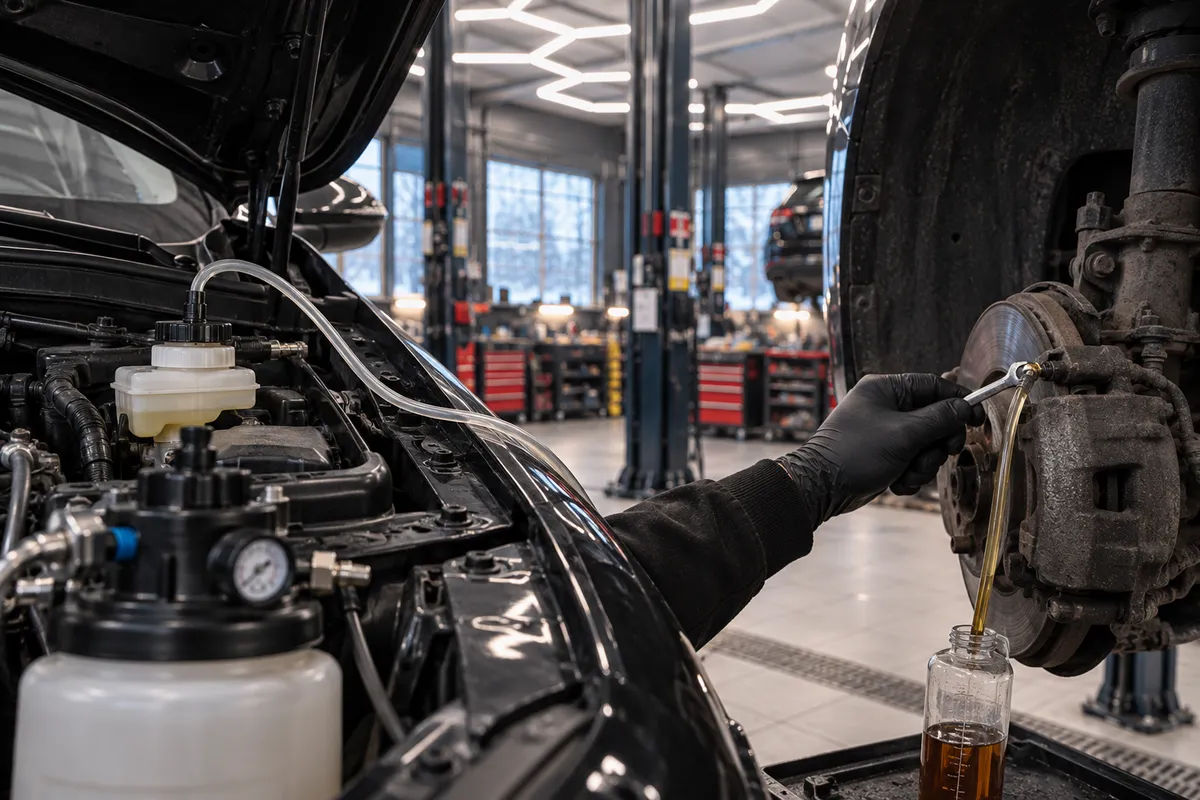
- 2We draw the old fluid out of the reservoir and fill it with fresh fluid.
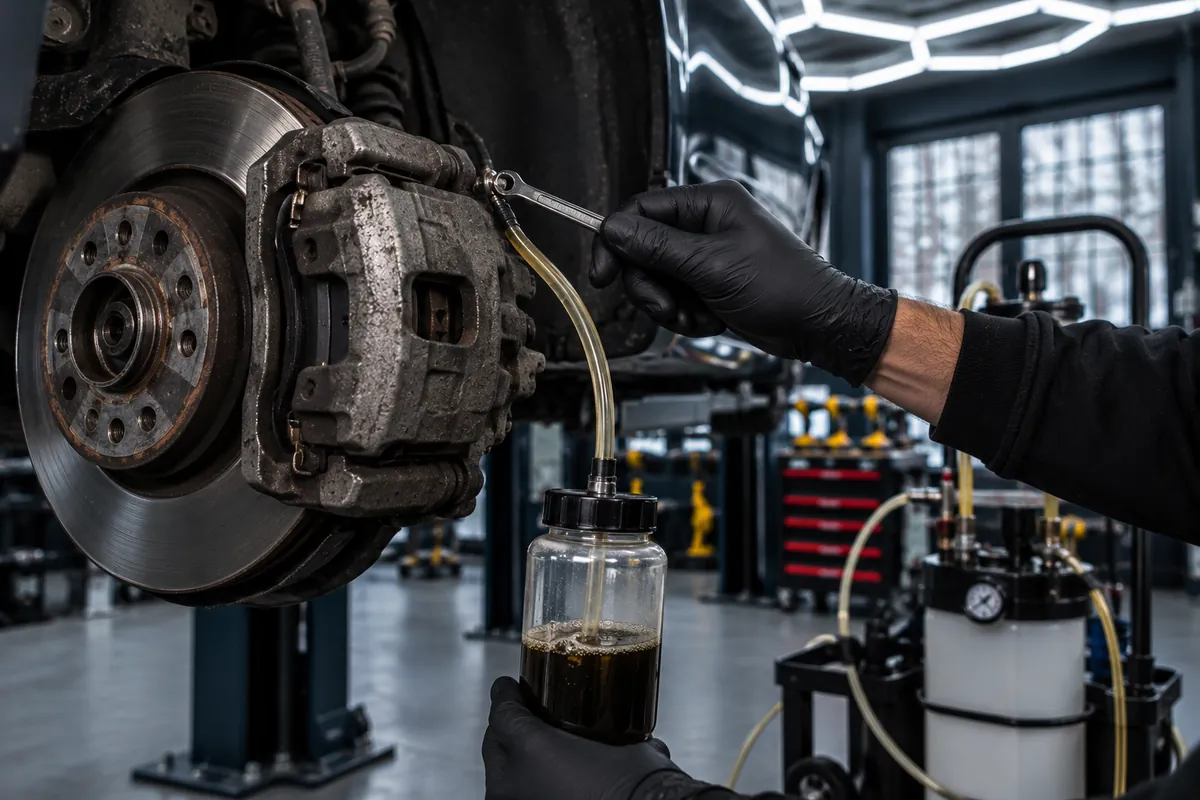
- 3We replace the fluid at each wheel in the order the manufacturer specifies, most often starting with the wheel furthest from the master cylinder. We push fluid through until clean, fresh fluid without bubbles comes out of the bleed nipple.
- 4If the car has a hydraulic clutch fed from the same reservoir, we also change the fluid in the clutch system.
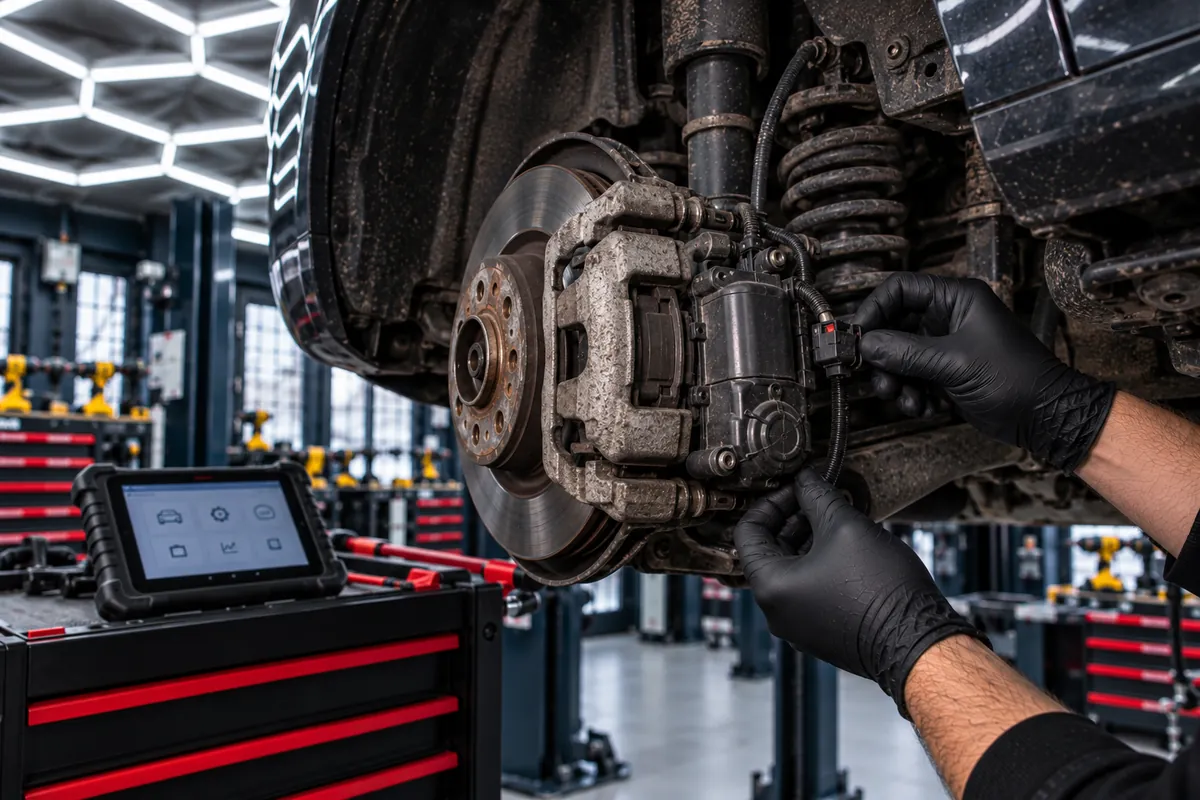
- 5In cars where the manufacturer’s procedure requires it, we use a diagnostic tool to run the ABS/ESP pump and valves so the fluid inside the unit is replaced too. This is especially important when air has got into the system.
- 6We top up to the MAX mark, check the bleed nipples for leaks and check the brake pedal.
- 7Finally, a test drive and a check of how the brakes work.
A fluid change is not just “topping up with fresh fluid”. All the old fluid has to be pushed out of the lines and calipers, and no air may remain in the system. It is also a good moment to look at the flexible hoses, bleed nipples and calipers — a seized bleed nipple can turn a simple service into a repair. That is why we assess the system first and only then start work.
How we check it at Pulsecar
- 1A talk with the driver: when the fluid was last changed, whether the pedal feels different from usual, whether any warning lights have come on.
- 2Measuring the fluid condition and checking the level in the reservoir.
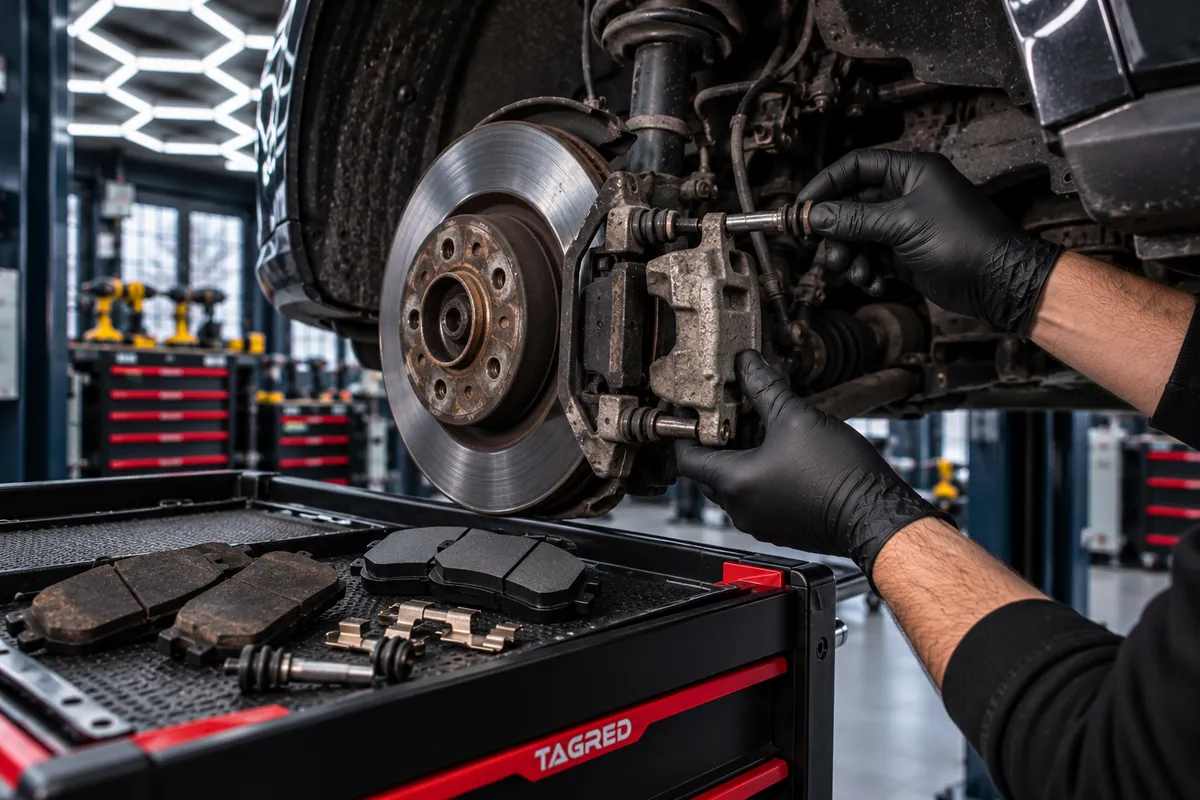
- 3Inspecting the system on the lift: hoses, calipers, bleed nipples, signs of leaks, pad thickness and disc condition.
- 4With an ABS or brake warning light — reading fault codes with a diagnostic tool.
- 5Presenting the result and a quote for approval. If we find more than just old fluid, we show it in photos and explain what is urgent and what can wait.
A brake fluid change is easy to combine with a pad or disc replacement or with a service — the car is on the lift anyway. More about brake system repairs is on the brakes page.
How much does a brake fluid change cost in Warsaw
| Service | Price (labour) |
|---|---|
| Brake fluid change with bleeding | from 200 zł |
| Brake pads front / rear | from 200 zł / from 250 zł |
| Pads and discs front / rear | from 300 zł / from 350 zł |
| Caliper repair, hose replacement | quoted after diagnosis |
Prices are for labour at Pulsecar; the fluid and parts are quoted separately depending on the model. The final cost depends on the car — for example, whether the change needs a tester procedure for the ABS unit or whether the clutch system also has to be done. Before work starts you receive a quote for approval. We give a 6-month warranty on labour. The full list is in our price list.
Can you drive with old fluid? Day to day the car usually brakes normally, but the safety margin under hard, prolonged braking is smaller. If the pedal is soft or sinks — do not put off a visit.
Brake fluid change in Warsaw Bielany — Pulsecar, ul. Arkuszowa 176
We change brake fluid at the Pulsecar workshop at ul. Arkuszowa 176 in Warsaw’s Bielany district. We are open Monday to Friday 09:00–18:00 and Saturdays 09:00–15:00. We speak Polish, Ukrainian, Russian, English and Belarusian.
The easiest way is to book online or call +48 571 058 591. If you have a service book or an invoice from the last change, bring it with you.