Tie rods and tie-rod ends — symptoms of wear, diagnosis and replacement
Play in the steering, knocking over potholes, uneven tyre wear and a car that pulls? It is often the tie rods or tie-rod ends. We explain the symptoms, inner rod versus outer end, the diagnosis and why wheel alignment is a must afterwards.
8 min read · Pulsecar team · updated:
Tie rods and tie-rod ends — the short answer
A worn tie rod or tie-rod end usually shows up as play in the steering (the car reacts late to small movements of the wheel), a dull knocking over bumps and drain covers, the car wandering at higher speeds, pulling to one side and uneven tyre wear — typically on the inner or outer edge of the tread. Often the first warning comes from the inspector at the technical inspection or from a workshop after checking the car on a play detector.
The repair is to replace the worn part — the end, the rod or both. After any such replacement the wheel alignment has to be set, because the length of the tie rod directly determines the toe. At Pulsecar, replacing a tie-rod end costs from 150 zł and wheel alignment costs 150 zł per axle. Below we cover the symptoms, causes, how we diagnose it and when play in the steering becomes dangerous.
Inner tie rod vs tie-rod end — the difference
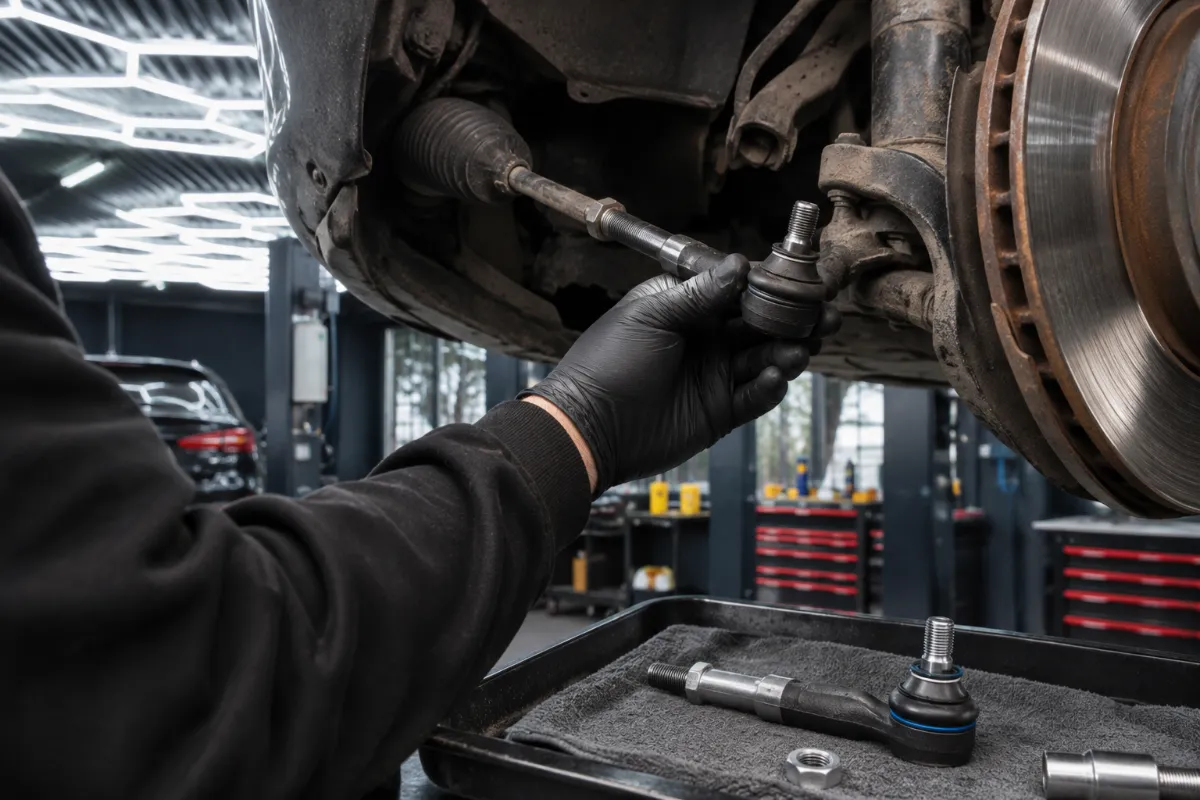
The inner tie rod (also called the axial rod) is screwed into the steering rack. At its inner end there is a ball joint hidden under the rubber rack boot (gaiter). The tie-rod end (outer end) is threaded onto the other end of the rod and connected to the steering knuckle through its own ball joint with a rubber boot. Together they transfer the movement of the steering wheel to the wheels.
Both wear in a similar way — play develops in the ball joint. The outer end works closer to the wheel and is more exposed to water, salt and impacts, so it usually wears first and is cheaper to replace. The inner rod normally lasts longer, but replacing it means taking off the outer end and the rack boot. Symptoms alone cannot tell you which joint has play — only a check on the lift can.
Remember that other parts give similar symptoms: control arm bushes, ball joints, wheel bearings, anti-roll bar links and the steering rack itself. That is why we always check the whole system, not just one part.
Symptoms of worn tie rods and tie-rod ends
- Play in the steering: when driving straight you can move the wheel slightly left and right and the car does not respond.
- Knocking or clunking from the front over potholes, speed bumps and kerbs, sometimes felt through the steering wheel.
- The car wandering at higher speeds — you have to keep correcting its line.
- Pulling to one side or an off-centre steering wheel when driving straight.
- Uneven tyre wear: a worn inner or outer edge of the tread, or feathered tread blocks.
- Steering wheel vibration at a certain speed or under braking (although wheels and brake discs are a more common cause).
- A torn rubber boot on the tie-rod end or a split rack gaiter — not a symptom of play yet, but a sign the joint will soon wear out.
If the steering wheel vibrates, also read our guide steering wheel shakes — vibration has many causes and worn tie rods are only one of them. If the steering feels heavy or uneven, the problem may be in the power steering: see power steering — symptoms.
Symptom → likely cause → what to do
| Symptom | Likely cause | What to do |
|---|---|---|
| Play in the steering when driving straight | Play in the tie-rod end or rod, less often in the steering rack | Suspension diagnostics, play detector check |
| Front knocking over bumps | Tie-rod end or rod, but also anti-roll bar links, control arm bushes and ball joints | Check the whole front suspension on the lift |
| Worn inner or outer edge of a tyre | Wrong toe — often caused by play in the tie rods or worn arm bushes | Fix the play first, then measure and set the alignment |
| Car pulls, off-centre steering wheel | Alignment, uneven tyre pressures, a binding brake, play in the steering | Check pressures, brakes and play, then alignment |
| Torn tie-rod end boot or rack gaiter | Ageing rubber, mechanical damage | Replace the boot or the part before the joint develops play |
| Heavy or uneven steering | Power steering, a seized joint, the rack | Diagnose the steering and power steering system |
Why tie rods and tie-rod ends wear out
- Hitting potholes, kerbs and speed bumps — every hard impact loads the ball joints.
- A split joint boot: water, sand and salt get in and the grease washes out. A joint like that wears very quickly.
- Mileage and age — the joints wear naturally, especially on heavier cars and wide tyres.
- Turning the steering wheel while stationary, especially with the wheels pressed against a kerb.
- Poor-quality parts — cheap replacements can develop play much sooner than good parts.
In Warsaw conditions — potholes, tram tracks, speed bumps and road salt in winter — steering joints have a hard life. So whenever your car is in a workshop, ask for a quick look at the joint boots: replacing a boot is simple, and saving the joint from water and grit spares you replacing the whole part later.
How we check it at Pulsecar
- 1A conversation with you: when the knocking or play appears, at what speed, whether the car pulls, when the alignment was last done.
- 2A test drive if the symptoms allow — we check how the car reacts to steering input, knocks and pulling.
- 3A check on the lift: we rock the wheel at the 3 and 9 o’clock positions — play in this direction usually points to the tie rod or end, while play at 12 and 6 o’clock suggests a bearing or ball joint.
- 4A play detector check: plates move the wheels in different directions while the mechanic watches each joint with a torch. This is the most reliable way to find play you cannot feel by hand.
- 5Inspection of joint boots, rack gaiters, bushes and anti-roll bar links, plus any power steering leaks.
- 6Tyre tread assessment — the wear pattern tells us whether the problem has been there for a while.
- 7A written quote: we show you what we found (photos included) and give a price. We only start work once you approve it.
Suspension diagnostics costs 100 zł. We check the whole front and rear, not only the steering, so you know straight away whether, for example, the control arm bushes need attention too.
Can you drive with play in a tie rod or tie-rod end?
Slight play that you can only just feel does not mean you have to pull over immediately, but do not put the repair off. Play grows over time, the car holds its line worse and worse and the tyres wear fast. An extremely worn joint can separate — the wheel is then no longer steered, which at speed can cause an accident.
Play in the steering is also a defect that can make the car fail the technical inspection at a vehicle inspection station. If the inspection is coming up, have the suspension checked beforehand — we will prepare the car, and the inspection itself is done at the SKP.
If play in the steering appeared suddenly, for example after hitting a kerb, or the steering wheel no longer returns to the straight-ahead position, keep driving to a minimum and come in for a check as soon as possible. A sudden change in how the steering behaves is a warning sign.
Replacing a tie rod or tie-rod end — and the mandatory alignment
- 1Before undoing the old part we measure its position or count the thread turns, so the new part ends up as close as possible to the previous setting.
- 2We undo the tie-rod end from the knuckle and unscrew it from the rod. When replacing the inner rod we also take off the rack gaiter.
- 3We fit the new part with new fixings where the manufacturer requires them and tighten it to the correct torque.
- 4If the rack gaiter is split, we fit a new one — an old, damaged gaiter would quickly ruin the new rod.
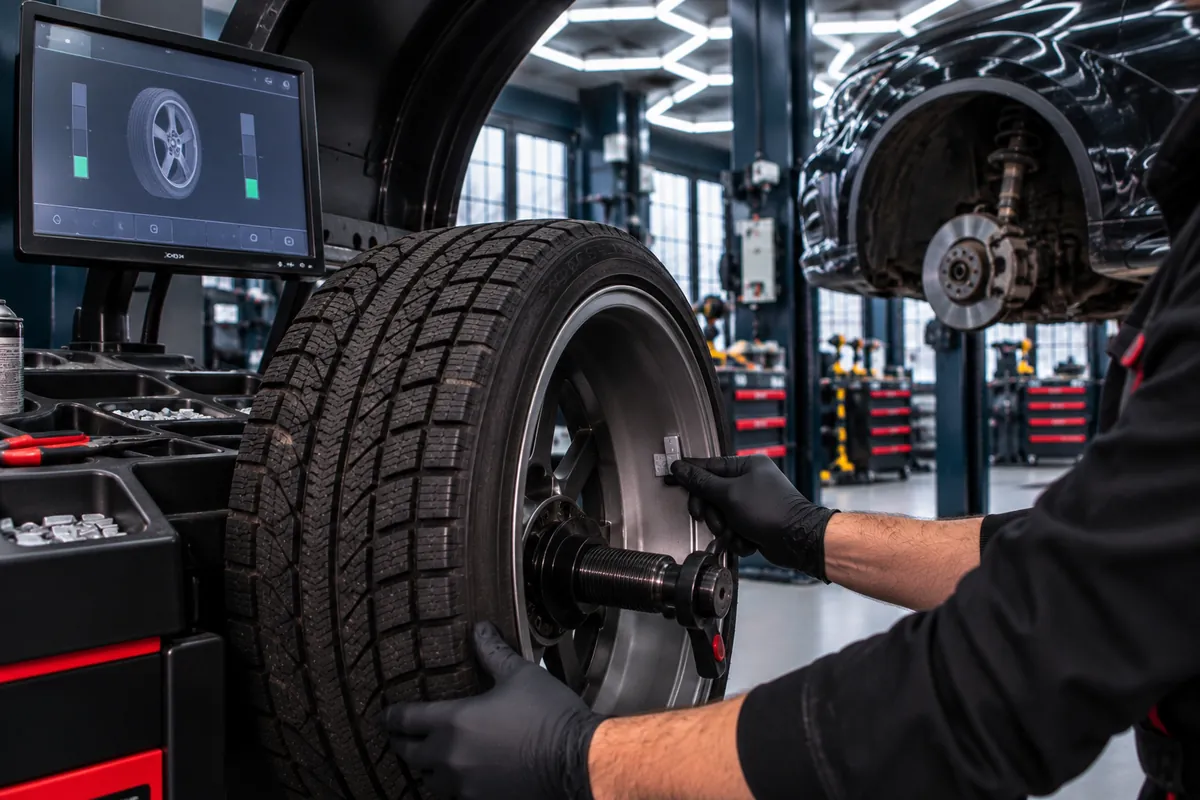
- 5We set the wheel alignment on the measuring rig and centre the steering wheel.
Counting thread turns is only an approximation — a new part is never exactly the same length as the old one, and even a small difference changes the toe. Without measuring the alignment the car may pull and the tyres can wear out within a few thousand kilometres. That is why alignment after replacing a tie rod or end is a mandatory part of the repair, not an extra. Read more in wheel alignment — when to do it and on our wheel alignment page.
Replacing in pairs is not mandatory. But if the other side already has noticeable play or a split boot, it makes sense to replace both at once — the alignment is set once for the whole axle anyway.
How much does tie rod and tie-rod end replacement cost
| Service | Price at Pulsecar |
|---|---|
| Suspension diagnostics | 100 zł |
| Tie-rod end replacement | from 150 zł |
| Wheel alignment — 1 axle | 150 zł |
| Wheel alignment — 2 axles | 300 zł |
| Inner tie rod replacement | price in the quote after diagnosis — depends on the car |
Prices are for labour; parts cost depends on the car model and the chosen brand. We give the final amount in a written quote after diagnosis, before any work starts. Labour carries a 6-month warranty, and new parts are covered by the manufacturer’s warranty. The full range of suspension work is on our suspension repair page.