Tyre storage — how to do it so your tyres last longer
Badly stored tyres age faster and can deform before they even go back on the car. We explain how to store wheels on rims and bare tyres, which conditions to avoid and when it is simpler to use a tyre hotel.
8 min read · Pulsecar team · updated:
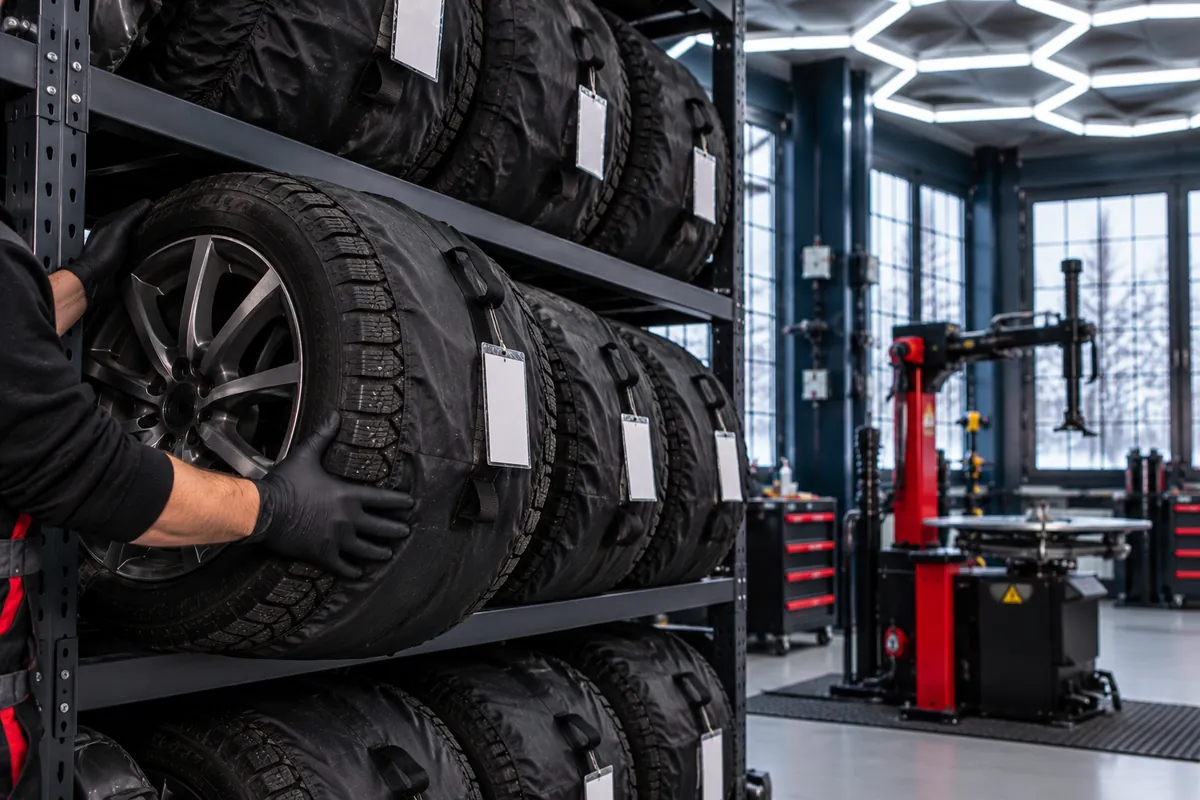
How to store tyres — the key rules in brief
- Cool and at a fairly steady temperature — away from radiators, boilers and sun-facing walls.
- Dark — out of direct sunlight, ideally in opaque covers.
- Dry — on a board, pallet or cardboard, not on bare concrete.
- Away from ozone and chemicals — electric motors, welders, fuel, oils and solvents.
- On rims — in a stack of up to 4 wheels or on a rack; without rims — upright and rotated.
- Clean and labelled — washed, dried, with the position on the car marked.
Tyres keep their properties longest in a cool, dry and dark place, away from heat sources, ozone and chemicals. Complete wheels (tyres on rims) are stored in a low stack or hung by the rim, while tyres without rims are stored upright and rotated every few weeks. Before storage, tyres should be washed, dried and marked with the position they came from on the car.
A badly stored tyre can lose a season or two of life: the rubber ages faster, cracks appear, and a tyre deformed under its own weight is harder to fit and balance. Below we explain how to store tyres at home, how wheels on rims differ from bare tyres, how to read a tyre’s age from the DOT code and when it is simpler to leave the set in a tyre hotel.
Tyres on rims or without — how storage differs
| Wheels on rims | Tyres without rims | |
|---|---|---|
| Best position | Flat in a low stack or hung by the rim | Upright, on the tread, side by side |
| What to avoid | A tall stack and hanging by the tyre itself | Hanging on a hook and lying in a stack for long |
| Pressure | Wheels stay inflated | Not applicable |
| Periodic task | Swap the order of wheels in the stack every few weeks | Rotate a quarter turn every 3–4 weeks |
| Space and weight | Heavier and bulkier — need a stable base or rack | Lighter, but easier to deform |
The difference comes down to what carries the weight. In a complete wheel the weight is carried by the rim and compressed air, so the tyre keeps its shape. A tyre without a rim has no support — in a stack the bottom tyres are squeezed by the ones above, and a tyre hung on a hook bends at one point of the bead. Such deformation is usually invisible to the naked eye, but it can make fitting and balancing harder.
Wheels on rims: stack, rack and pressure
- Stack — no more than 4 wheels on top of each other, on a clean, dry base (board, cardboard, pallet), not directly on concrete.
- Every few weeks swap the order: move the bottom wheel to the top so the load is spread evenly.
- Rack or wall hanger — the wheel hangs by the rim’s centre bore and nothing presses on the tyre; a handy solution in a garage.
- A wheeled stand and covers with handles make carrying easier, but they don’t replace a suitable place.
Wheels on rims are stored inflated. A pressure close to the car’s recommended value helps the tyre keep its shape and protects the bead from deforming. Some guides recommend adding about 0.3–0.5 bar above spec, because air naturally escapes over several months — that is sensible, as long as you reset the pressure before fitting.
Look after the rims too. Brake dust and road salt residue speed up corrosion, especially on alloy rims with damaged paint. Washed and dried rims will come through the season in much better shape.
Bolts or nuts for alloy rims often differ from those for steel rims in length or seat shape. Keep them with the set in a labelled bag and don’t forget the locking wheel bolt key.
Tyres without rims: upright and rotated
- Don’t hang tyres without rims on a single hook — the bead bends at one point.
- Don’t put heavy objects on tyres or squeeze them into a tight cupboard.
- Watch out for sharp shelf edges, nails and tools.
- Don’t leave tyres on a wet floor or under a leaking roof.
Bare tyres are best stood upright, on the tread, side by side — on a shelf, rack or board. Every 3–4 weeks rotate each one a quarter turn so that the same section in contact with the floor doesn’t keep deforming.
If space is short and the tyres have to lie in a stack, limit it to 4 and change the order every few weeks. That is acceptable for a short time, but for a whole season the upright position works better.
Tyres without rims take up less space, but every season they have to be fitted onto rims and balanced. A second set of rims is an upfront cost that makes later seasons easier and spares the tyre bead from frequent fitting.
Temperature, light, ozone and moisture — what rubber dislikes
| Factor | How it harms the tyre | How to protect it |
|---|---|---|
| Heat | Speeds up rubber ageing and loss of elasticity | A cool place, away from radiators, boilers, heating pipes and sun-facing walls |
| Large temperature swings | Condensation, extra stress in the rubber | A room with a fairly stable temperature, not an open balcony |
| Sunlight (UV) | Cracking and a network of fine lines on the surface | A dark room or opaque covers |
| Ozone | Fine cracks, especially where the rubber is under stress | Away from electric motors, welders, compressors, battery chargers and UV lamps |
| Moisture | Rim and valve corrosion, mould in covers | A dry place, dry tyres before storage, a base instead of a bare floor |
| Chemicals | Swelling and weakening of the rubber | Away from fuel, oils, solvents, paints and road salt |
The best place is a dry, dark room with a moderate and fairly stable temperature — e.g. a cool basement or an unheated garage that doesn’t freeze through. The worst options are a balcony, a loft that heats up in summer and a corner next to a boiler.
Frost on its own doesn’t damage a tyre lying undisturbed, but cold rubber is less flexible. Tyres brought from a freezing garage are best left somewhere warm for a while before being fitted onto rims.
Covers protect against light and dust, but only put dry tyres into a sealed bag. Moisture trapped in plastic won’t evaporate all season.
How to prepare tyres for storage — step by step
- 1Before removing the wheels, mark their position on the car: FL (front left), FR, RL, RR — with tyre chalk, a marker or a tag.
- 2Wash the tyres and rims with water and a mild cleaner, removing mud, salt and brake dust. Don’t use petrol, solvents or solvent-based tyre shine.
- 3Pick stones and other objects out of the tread grooves.
- 4Dry the wheels thoroughly — ideally leave them for a few hours in a well-ventilated place.
- 5Inspect the tyres: measure the tread, check the sidewalls for cracks and bulges, read the production date from the DOT code. Make a note if the set will need replacing before next season.
- 6Inflate wheels on rims to a pressure close to the recommended value or slightly higher.
- 7Pack the tyres in dry, opaque covers and position them correctly: wheels in a low stack or on a rack, bare tyres upright.
- 8Put the bolts, hubcaps and locking bolt key in a labelled bag and keep them with the set.
Marking the position helps at the next fitting: it lets you swap wheels between axles in a planned way and notice whether any tyre is wearing abnormally. With directional tyres, note the rotation arrow; with asymmetric tyres, the OUTSIDE marking must face the outer side of the wheel.
Tyre age and the DOT code — storage doesn’t stop the clock
| DOT code (last 4 digits) | Production date | Age in autumn 2026 |
|---|---|---|
| 1224 | Week 12 of 2024 | approx. 2.5 years |
| 4520 | Week 45 of 2020 | approx. 6 years — careful check every season |
| 0816 | Week 8 of 2016 | over 10 years — consider replacing |
Rubber ages even when a tyre is not in use. Good storage conditions slow the process down but don’t stop it. That is why, apart from the tread, it is worth watching the production date: the last four digits of the DOT marking on the sidewall are the week and year of manufacture.
Tyres older than about 6 years deserve a careful look every season — check for fine cracks on the sidewall and at the base of the grooves, and for a hard, “glassy” surface. Many tyre and car manufacturers recommend taking tyres out of service no later than about 10 years after production, regardless of tread depth. Specific recommendations vary between manufacturers.
After storage — what to check before fitting
- Tread — a sensible minimum is about 4 mm for winter tyres and about 3 mm for summer tyres; the legal minimum is 1.6 mm.
- Sidewalls and grooves — cracks, bulges and deformation after storage.
- Pressure — reset it according to the sticker on the door pillar or fuel filler flap.
- Balancing — worth doing at every set change, because weights can fall off and the mass distribution changes as the tyre wears.
- TPMS sensors — after fitting, check that the car detects them; with an indirect system, calibrate it from the car menu (see tyre pressure warning light).
- Rotation — following the markings, tyres in better condition usually go on the rear axle.
We cover timing and seasonal change rules in our guide on when to switch to winter tyres. If one tyre is clearly worn on one side, also check the wheel alignment.
How much does tyre storage cost in Warsaw?
| Service | Price |
|---|---|
| Tyre storage (1 season) | 200 zł |
| Tyre change R14 | 180 zł |
| Tyre change R15 | 200 zł |
| Tyre change R16 | 220 zł |
| Tyre change R17 | 240 zł |
| Tyre change R18 | 260 zł |
| Tyre change R19 | 280 zł |
| Tyre change R20 | 300 zł |
| Tyre change R21 | 320 zł |
| Wheel alignment — 1 axle / 2 axles | 150 zł / 300 zł |
A tyre hotel mainly solves the problem of space and logistics. We take the set off at the seasonal change and it stays with us until the next one — you arrive and leave with an empty boot. On intake the set is labelled and we look at the visible condition of the tyres and tread; if something is not fit for another season, we will tell you at the change.
At Pulsecar storing a set of tyres costs 200 zł per season. The service goes with the seasonal tyre change and is charged separately — the change price depends on the rim size. You always get a quote to approve before work starts, and we give a 6-month warranty on labour.
A visual inspection does not reveal all internal tyre defects, so further use depends on the technical condition checked before every fitting. If you have a dry, cool, dark place and a rack at home, storing tyres yourself is a good solution too — just stick to the rules above.
You will find details on the tyre storage and tyre change pages, and the full price list on the prices page.
Example: for R15 rims it is 200 zł for the change and 200 zł for a season in storage, 400 zł in total; for R17 — 240 zł + 200 zł, i.e. 440 zł.
Tyre storage in Warsaw Bielany — Pulsecar, ul. Arkuszowa 176
We store tyres at the Pulsecar workshop at ul. Arkuszowa 176 in Warsaw’s Bielany district — convenient for drivers from Żoliborz, Bemowo and Łomianki. We are open Monday to Friday 09:00–18:00 and Saturdays 09:00–15:00.
The best way to get a slot is online booking — you can tick tyre storage right in the form. You can also call +48 571 058 591 or set a tyre change reminder. Directions are on the contact page.