Driveshaft and CV joint — clicking when turning, vibration, split boot and repair
Rhythmic clicking when pulling away with the wheels turned, vibration under acceleration or grease sprayed over the inside of the rim are typical signs of a worn driveshaft or CV joint. We explain what causes them, what to replace and whether you can keep driving.
7 min read · Pulsecar team · updated:
CV joint clicking when turning — the short answer
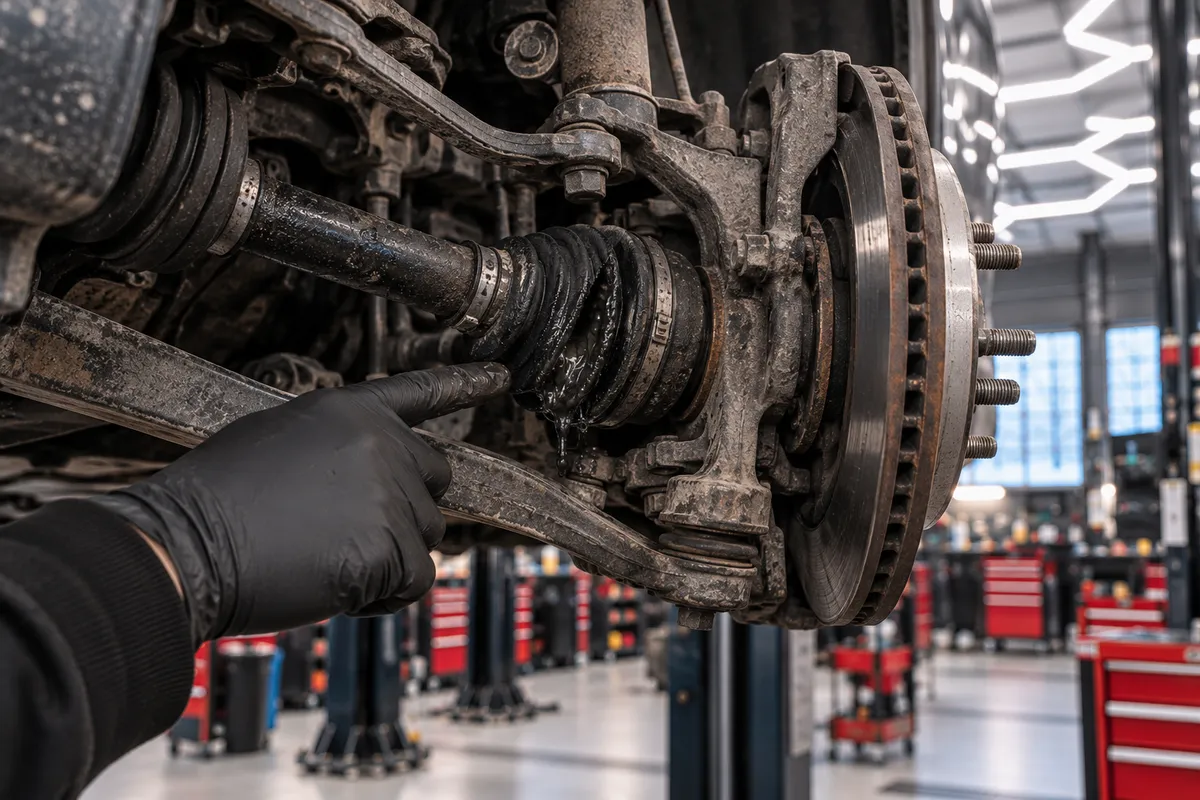
A rhythmic clicking or cracking you hear when pulling away and accelerating with the wheels turned hard — in a car park, on a roundabout, when making a U-turn — is most often a worn outer CV joint on the driveshaft. Vibration of the whole car under acceleration that disappears when you lift off points rather to the inner joint (tripod). The story almost always starts with a split rubber CV boot: the grease escapes, water and grit get in, and the joint wears quickly.
If the boot is caught early, replacing it with fresh grease is often enough. Once the joint is clicking, you need a new joint or a whole driveshaft. You can drive with a worn joint for a while, but the problem gets worse, and in the extreme the joint can break up and the car loses drive. A driveshaft replacement at Pulsecar costs from 250 zł in labour.
How a driveshaft is built
- Outer joint (ball type, at the wheel): lets the wheel steer while still transmitting drive. It works at large angles, which is why it is the one that usually clicks when turning.
- Inner joint (at the gearbox, often a tripod): lets the driveshaft change length as the suspension moves up and down. When worn it gives vibration under acceleration, not clicking when turning.
- CV boots (rubber or plastic): keep the grease in and water, salt and grit out. They are the weakest link of the whole driveshaft.
- Shaft: in some cars one driveshaft is longer and has a support bearing on a bracket by the engine — its wear also causes vibration and humming.
- ABS ring: in many cars it sits on the outer joint housing, so a damaged joint or ring can turn on the ABS light.
Front-wheel-drive cars have driveshafts, as do many rear-wheel-drive cars with independent suspension, and in 4x4 cars all driven wheels do. The principle and the symptoms of wear are similar.
Symptoms of a worn driveshaft and CV joints
- Clicking or cracking when pulling away with the wheels turned, getting faster with the wheel — the classic outer joint symptom.
- Vibration under acceleration, especially with more throttle and a loaded car, disappearing when coasting — typical of the inner joint.
- A clunk when pulling away or when going from throttle to engine braking — play in the joints or on the splines.
- Grease sprayed over the inside of the rim, the control arm, caliper or underbody — a split boot.
- Humming or vibration at cruising speed — in cars with a driveshaft support bearing or with a bent shaft.
- ABS light after replacement or damage to a joint — the ABS ring is damaged or missing on the new joint.
Not every knock when turning is a CV joint. Similar noises can come from worn tie-rod ends, control arm bushes, top strut mounts or even a hub nut that has not been tightened properly. A hum that changes with speed is more often a wheel bearing than a driveshaft — more in our guide wheel bearing symptoms.
Symptom → possible cause → what to do
| Symptom | Possible cause | What to do |
|---|---|---|
| Clicking when pulling away with wheels turned | Worn outer CV joint | Replace the joint or the driveshaft |
| Vibration under acceleration, gone off the throttle | Worn inner joint (tripod), support bearing | Check for play, replace the joint or driveshaft |
| Grease on the rim, no clicking | Split CV boot | Replace the boot quickly, with cleaning and new grease |
| Hum increasing with speed | Wheel bearing | Suspension diagnostics, bearing play check |
| Knocks over bumps, also driving straight | Control arm bushes, anti-roll bar links, shock absorbers | Suspension diagnostics on the lift |
| Steering wheel shake at speed | Wheel balance, rims, discs, sometimes the driveshaft | Balancing, suspension diagnostics |
| ABS light after a repair | ABS ring or sensor | Read fault codes, check the ring and sensor |
Knocks over bumps that you also hear driving straight are usually the suspension, not the driveshaft — see our guide control arm and bushes replacement. If the steering wheel shakes at a certain speed, read steering wheel shaking.
Split CV boot — why you need to act fast
The boot flexes with every turn of the wheel and every steering input, and in winter it gets salt and frost. With age the rubber hardens and splits, most often in the folds. Through the split the grease is flung out by centrifugal force, and water and grit get in. A joint with grit inside wears quickly — sometimes within a few weeks, sometimes a few months, depending on the weather and mileage.
If the joint is not clicking yet and the boot split recently, replacing the boot is usually enough: the joint is taken off, cleaned, checked, packed with new grease and fitted with a new boot and clips. That is much cheaper than a new joint. Once the joint is clicking, or there is grit and rust in the grease, a boot alone will not help — the joint or the whole driveshaft has to be replaced.
Look at the CV boots whenever the tyres or oil are changed. A quick look with a torch with the wheels turned is enough — a trace of grease on the rim or control arm is a signal not to wait.
What to replace: the boot, the joint or the whole driveshaft
| Situation | What is usually enough | Notes |
|---|---|---|
| Split boot, joint quiet and without play | Boot replacement with cleaning and new grease | The cheapest option, but only when the joint is clean and sound |
| Outer joint clicking, rest of the driveshaft fine | Outer joint with a new boot | Joints are often sold as a kit with boot, clips and nut |
| Vibration from the inner joint | Inner joint or the whole driveshaft | In many cars replacing the whole driveshaft is simpler and sensibly priced |
| Both joints worn, corroded shaft, damaged ABS ring | Whole driveshaft | A new or remanufactured driveshaft shortens labour time |
The choice depends on the driveshaft's condition, parts availability and price for the specific model. Sometimes a complete new driveshaft costs little more than a good joint, saves labour and gives new boots at both ends. We will show you the options in the quote and tell you which makes sense for your car. On fitting we always tighten the hub nut to the manufacturer's torque — in many cars it is single-use and is replaced with a new one.
How we check it at Pulsecar
- 1A talk with you: when you hear the knock — turning left, turning right, pulling away, over bumps — and whether there is vibration under acceleration.
- 2A test drive: pulling away with the wheels turned hard in both directions, accelerating straight under load, coasting for comparison.
- 3Inspection on the lift: boot condition, grease traces, rotational play in the driveshaft and joints, support bearing, ABS ring.
- 4A suspension check at the same time: control arm bushes, ball joints, tie-rod ends, wheel bearings — to rule out other sources of knocks.
- 5The result with photos and a written quote with options (boot, joint, driveshaft) for approval before work starts.
After a driveshaft replacement a wheel alignment is usually not needed. If on your car parts that affect the wheel settings have to be undone, we will tell you in advance. More about suspension repairs is on the suspension page.
Can you drive with a clicking CV joint?
A slightly clicking outer joint will not usually fall apart overnight, so you can drive to the workshop calmly. Do not put off the repair, though: the clicking will get worse, and a badly worn joint can seize or break up. Then the car loses drive on that wheel, and pieces of the driveshaft can damage boots, brake lines or the gearbox. At speed or in the middle of a junction that is simply dangerous.
A split boot without clicking is a job for the next few days, not months — the sooner, the better the chance that a boot alone will do. Strong vibration under acceleration is also not something to live with for long, as it loads the engine mounts and the gearbox.
If the clicking has suddenly become very loud, you hear grinding, or the car will not move although the engine is running and a gear is engaged, do not drive on — bring it in on a tow truck.
How much does a driveshaft or CV joint replacement cost in Warsaw
| Service | Price (labour) |
|---|---|
| Suspension diagnostics | 100 zł |
| Driveshaft replacement | from 250 zł |
| CV boot or joint replacement | priced in the quote after diagnosis |
| Wheel alignment — 1 axle / 2 axles (if needed) | 150 zł / 300 zł |
Prices are for labour at Pulsecar; the driveshaft, joint or boot is priced separately depending on the model and the parts option chosen. Labour time depends on the suspension design and the state of the fixings — heavily corroded bolts and seized splines can lengthen the job. You get the exact amount in the quote before work starts. We give a 6-month warranty on labour and the manufacturer's warranty on new parts. The full list is in our price list.
We are at ul. Arkuszowa 176 in Bielany, open Monday to Friday 09:00–18:00 and Saturdays 09:00–15:00. You can book online or call +48 571 058 591.