Car air conditioning disinfection — when and how to do it properly
A musty smell from the vents and windows that fog up quickly? It is usually bacteria and mould on the evaporator. We explain where the smell comes from, which disinfection methods work, how often to do it and what you can do yourself to keep it from coming back.
8 min read · Pulsecar team · updated:
A/C disinfection — the short answer
A musty, cellar-like smell from the vents almost always means that bacteria and mould have grown on the air-conditioning evaporator and in the ventilation ducts. The evaporator is permanently damp, dark and hidden under the dashboard, and a dirty cabin filter lets dust, pollen and bits of leaves reach it. Effective disinfection is not just an air freshener sprayed into the vents but a complete job: a new cabin filter, a cleaner applied directly to the evaporator, a check of the condensate drain and — if needed — additional treatment of the cabin with ozone or ultrasonic fogging.
The sensible interval is once a year, ideally in spring before the hot season, together with an A/C service. If an allergy sufferer or a child travels in the car, or the smell comes back quickly, it is worth doing more often, for example in spring and autumn. Below we explain how the individual methods work, how they differ and what you can do yourself to keep the evaporator clean for longer.
Where the unpleasant A/C smell comes from
- Moisture on the evaporator: while the A/C is running the evaporator is cold and water vapour from the air condenses on it. After you switch off the engine the water stays between the fins, and in a warm car this creates ideal conditions for microorganisms.
- A dirty or old cabin filter: it traps dust and pollen, but after a year or so it becomes a breeding ground for bacteria itself, and when damp it can smell like a wet cloth.
- Leaves and dirt under the scuttle panel: plant debris in the scuttle and around the fresh-air intake rots and smells even with the A/C switched off.
- A blocked condensate drain: water does not drain out under the car but sits in the evaporator housing — the smell is much stronger and sometimes the carpet gets wet.
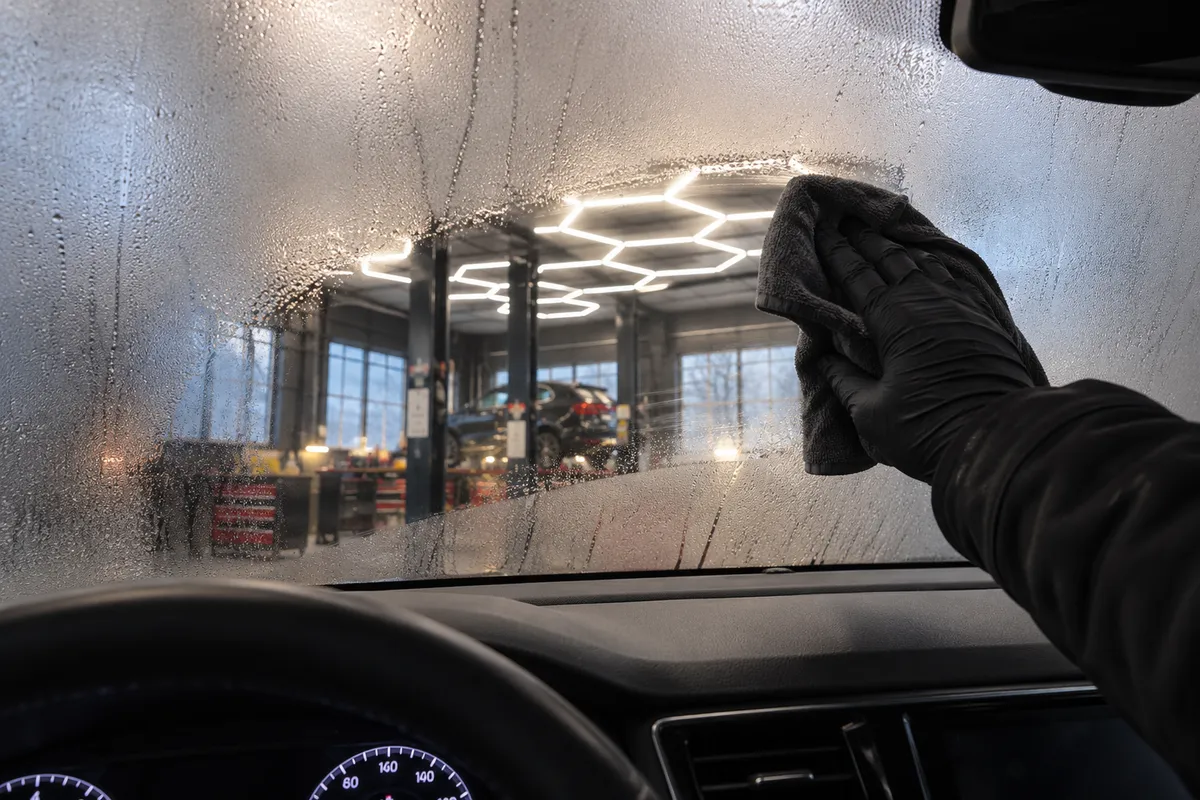
- Driving on recirculation all the time: the air in the cabin becomes humid, the windows fog up faster and the evaporator struggles to dry out.
- Rarely used A/C: a system left switched off all winter is more likely to smell when you first turn it on in spring.
The typical pattern looks like this: for the first few minutes after switching on the fan you can smell mustiness, then the smell fades. This shows that the source is in the evaporator housing rather than in the cabin itself. If the smell is sweet and chemical, that is a different problem — see the table section.
Symptoms — when disinfection is needed
| Symptom | Most likely cause | What to do |
|---|---|---|
| Musty smell for the first few minutes after switching on the fan | Bacteria and mould on the evaporator | Evaporator disinfection and a new cabin filter |
| Smell even with the A/C switched off | Damp cabin filter, leaves under the scuttle panel | Replace the filter, clean the scuttle and air intake |
| Wet carpet on the passenger side, sloshing water | Blocked or disconnected condensate drain | Clear the drain, then disinfect |
| Windows fog up faster than they used to | Clogged filter, moisture in the ventilation, weak A/C performance | Replace the filter, check the A/C and its tightness |
| Weak airflow at maximum fan speed | Clogged cabin filter or evaporator covered in dirt | Replace the filter, assess the evaporator |
| Sweet smell and greasy film on the windows | Possible coolant leak from the heater matrix | Cooling system diagnosis — disinfection will not help here |
| A/C cools poorly | Low refrigerant, a leak, compressor fault | Vacuum leak test and A/C recharge |
The last two rows are an important caveat: not every smell and not every weak A/C is a job for disinfection. A sweet smell may mean a leaking heater matrix — read more in our guide heater not working. If the windows fog up even though the A/C works, see the article foggy windows in the car.
Cabin filter — the first step, without which the rest does not work
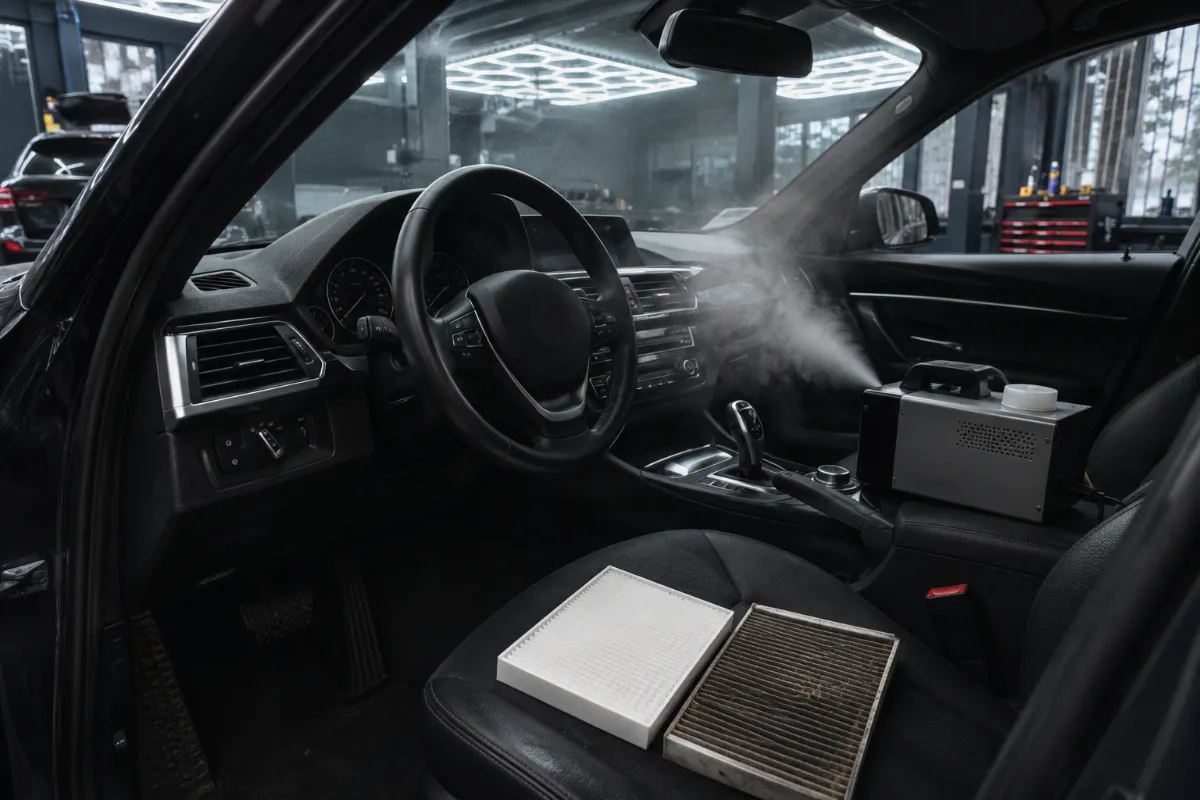
Disinfection without replacing the cabin filter makes little sense: the cleaner will treat the evaporator, but an old, damp filter will quickly start releasing smell and spores again. That is why we always replace the filter when disinfecting, and if it was changed recently we check its condition.
It is worth changing the cabin filter every year or every 15,000 km — more often if you drive mainly in town, on gravel roads or park under trees. You can choose standard (paper) filters, activated carbon filters, which also absorb some odours and exhaust fumes, and filters with an antibacterial layer. For allergy sufferers and those who drive in heavy traffic we recommend an activated carbon filter.
In some cars the filter sits behind the glovebox and takes a few minutes to change; in others you need to remove the scuttle covers or dashboard trim. While you are at it, clear leaves from the scuttle and check there is no standing water.
When fitting a new filter, look for the airflow direction arrow on the filter frame. A filter fitted the wrong way round works less well, and in some cars it also seals poorly in its housing.
Disinfection methods — foam, ozone, ultrasonic fogging
| Method | How it works | Pros and limitations |
|---|---|---|
| Foam or spray on the evaporator | A disinfecting cleaner applied with a probe through the condensate drain, a service opening or from the filter side, directly onto the evaporator fins; it drains out together with the dirt | Works where the smell is produced. Needs access to the evaporator and a clear drain |
| Ozone treatment | An ozone generator produces ozone in the closed cabin while the system runs on recirculation; ozone oxidises bacteria and odour molecules | Good for smells in upholstery and ducts. Reaches deep into the evaporator less well; the car must be thoroughly aired afterwards |
| Ultrasonic fogging | The device turns a disinfecting liquid into a very fine mist which the blower spreads through the ducts and evaporator | Reaches the ventilation ducts and leaves no wet patches. Effectiveness depends on the product and treatment time |
| Shop-bought vent spray | An aerosol sprayed into the vents or set off in the cabin on recirculation | Cheap, but mainly freshens. With a strong smell the effect usually wears off within days |
The most effective approach is a combination: foam or spray applied directly to the evaporator, followed by ozone or ultrasonic fogging for the cabin and ducts. Ozone alone, or a spray into the vent grille alone, usually only masks the smell for a while. Also remember that no method will solve the problem if the condensate drain is blocked or the evaporator is heavily caked with dirt — then the cause has to be found first.
The condensate drain — a small tube, a big problem
Water condensing on the evaporator runs out under the car through a drain tube. That is why a puddle of clear water under the car on a hot day, usually near the bulkhead, is normal. What is worrying is rather the absence of water when the A/C is working hard.
The drain can get blocked with leaves, sand, insects or bacterial slime, and sometimes the tube slips off its spigot. Water then collects in the evaporator housing — the smell gets stronger, you can hear sloshing when braking, and in extreme cases water spills onto the passenger-side carpet. Long-term moisture under the carpet can damage wiring looms and control modules, which in some cars sit in the floor.
Every time we disinfect we check that the drain is clear and blow it through or unblock it if needed. It is one of the simplest jobs, yet it often decides whether the smell returns after a month or after a year.
How often to disinfect the A/C and everyday care
- Switch off the A/C (the A/C button) 3–5 minutes before the end of your journey but keep the fan running — warm air will dry the evaporator.
- Do not drive on recirculation all the time; use it briefly, for example in a tunnel or in traffic behind smoky vehicles.
- Use the A/C in winter too — it dries the air, helps with foggy windows and keeps the compressor seals in good condition. In hard frost the compressor may not engage, which is normal.
- Clear leaves from the scuttle panel and around the air intake below the windscreen.
- Replace the cabin filter every year, not just when you happen to remember.
As standard we recommend disinfection once a year, ideally in spring, together with a cabin filter change and an A/C check. If allergy sufferers or small children travel in the car, or it is parked under trees, a second treatment in autumn makes sense. Everyday habits matter a lot too:
Some cars have an evaporator drying function after the engine is switched off (so-called afterblow) — the blower runs briefly after you park. If your car has it, it is worth enabling it in the settings or asking for it to be activated during diagnostics.
Disinfection vs A/C recharge — two different services
Disinfection is about the cleanliness of the ventilation system, while an A/C recharge is about the amount of refrigerant. One does not replace the other: a clean evaporator will not improve cooling if the system is short of refrigerant, and a freshly recharged system can still smell musty.
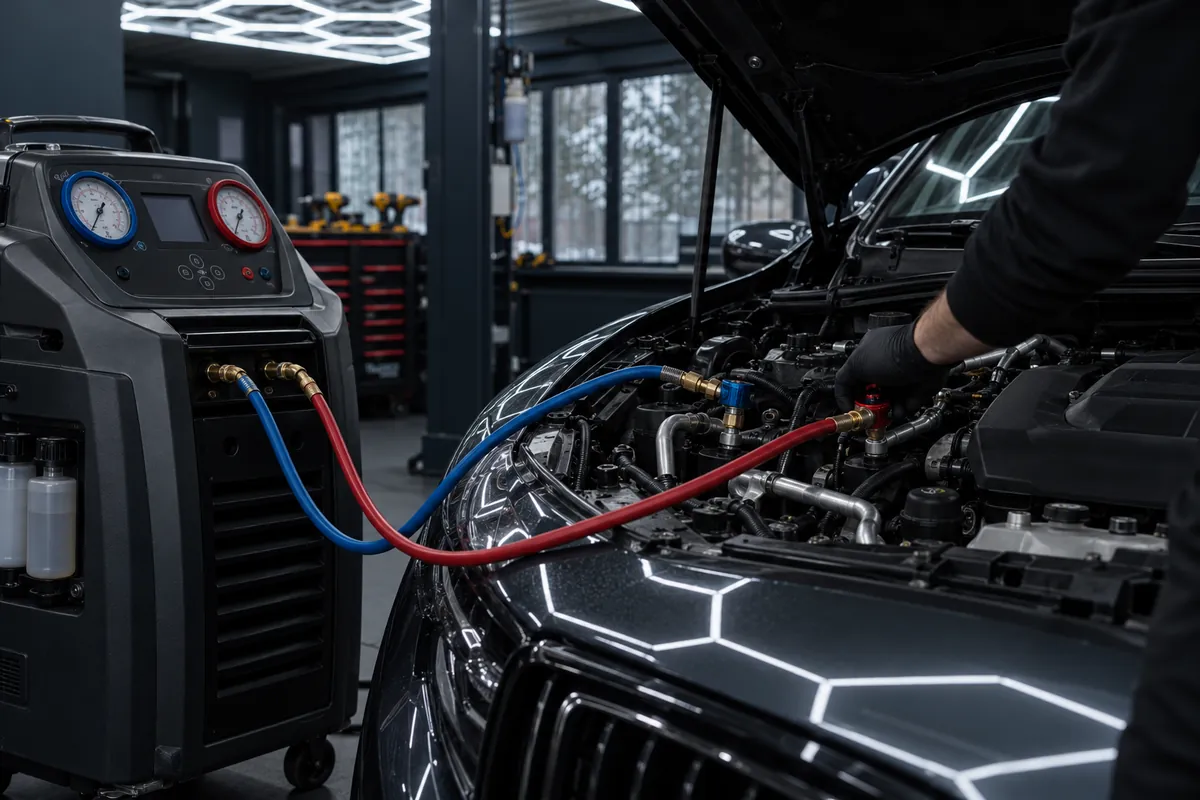
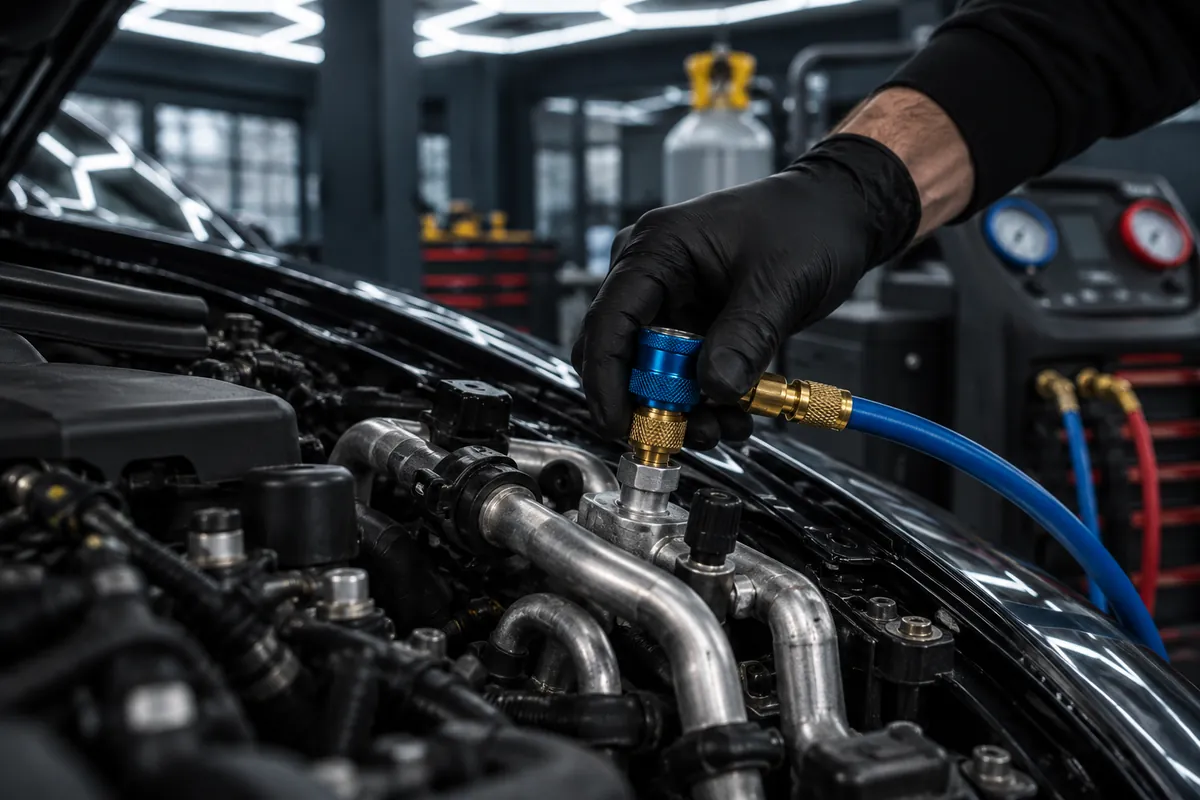
In practice it is best to do both in one visit. An A/C service includes recovering the refrigerant, a vacuum (leak) test, filling with the correct amount of refrigerant and oil, and measuring the vent temperature. You can read more about what a recharge involves and how often to do it in our guide A/C recharge, and about the differences between refrigerants in R1234yf or R134a.
How we do it at Pulsecar
- 1A short chat: when the smell appears, whether the windows fog up, whether the A/C cools well and whether it was serviced recently.
- 2Check of the cabin filter, scuttle panel and air intake; replacing the filter with a new one (standard or activated carbon).
- 3Checking that the condensate drain is clear and unblocking it if needed.
- 4Disinfecting the evaporator with a product applied directly to it, followed by the cabin and ventilation ducts — the method depends on the car and how strong the smell is.
- 5If the A/C cools poorly — a service with a vacuum test and recharging with the correct amount of refrigerant.
- 6Finally, measuring the vent temperature and checking that the smell has gone. We show you what we found, for example an old filter or a blocked drain.
Air conditioning is one of the most common jobs in our workshop this year, so the procedure is well established. We agree the scope of work and the price before we start — no surprises on the bill. You will find details of the service on the air conditioning page.
How much does A/C disinfection cost
| Service | Price |
|---|---|
| A/C recharge with vacuum test | from 199 zł |
| Refrigerant R134a or R1234yf, 100 g | 40 zł |
| Cabin filter replacement | 40 zł |
| A/C disinfection | as part of the A/C service, price given before work |
We carry out disinfection as part of the A/C service, and its price depends on the car, access to the evaporator and the chosen method — we give it to you before starting work. Full prices are in our price list.
Pulsecar is at ul. Arkuszowa 176 in Bielany, Warsaw, open Monday to Friday 09:00–18:00 and Saturday 09:00–15:00. Book a visit online or call +48 571 058 591. Spring is the best time, before the heat and the queues for A/C servicing begin.