
Range Rover Air Suspension Sinking When Parked
If your Range Rover sinks when parked, one possible cause is a leak in an air spring, a line or the valve block. The problem may also lie with the compressor, the height sensors or the suspension control system. A suspension check at Pulsecar costs 100 zł, and we define the scope of the repair after inspecting the system.
If your Range Rover is visibly leaning, the suspension has dropped to its lowest position or a wheel is rubbing on the wheel arch, do not keep driving until it has been checked.
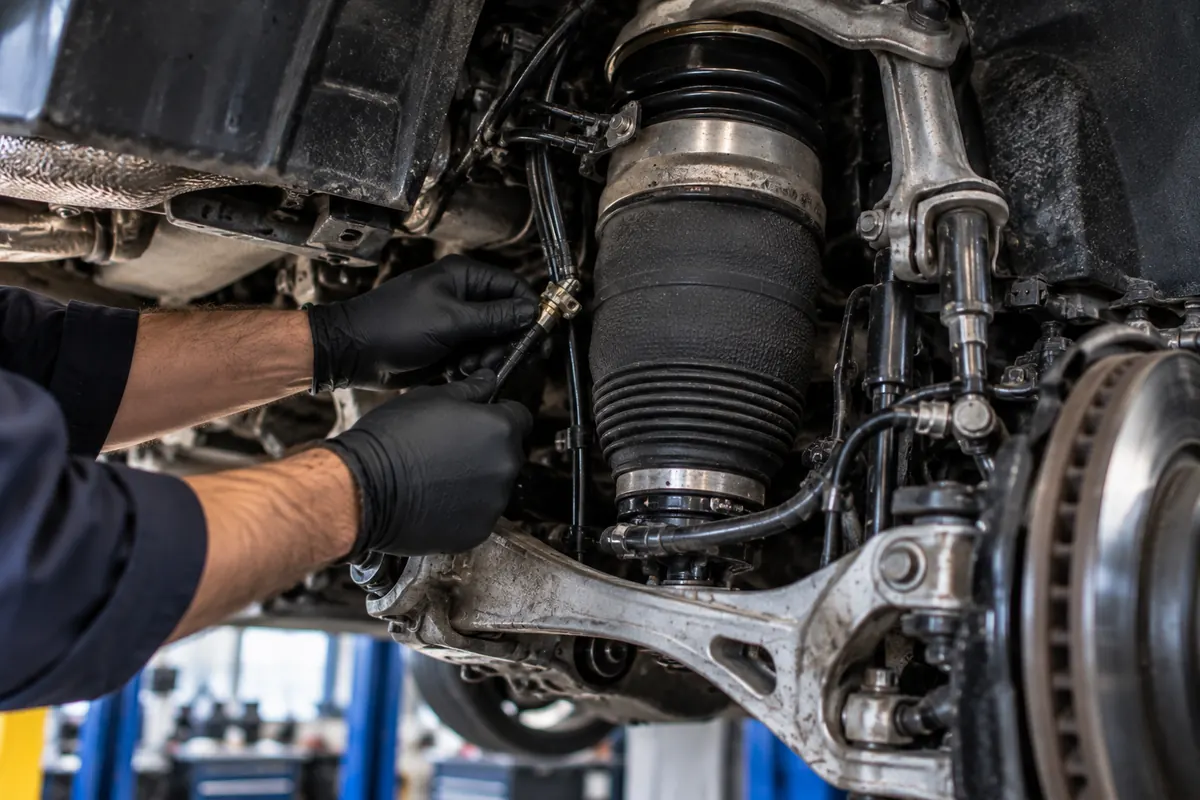
Which Range Rover models have air suspension?
Air suspension has been used in various generations of the Range Rover, the Range Rover Sport and selected other models from the brand. The design varies depending on the generation, equipment and vehicle configuration.
The system uses air components, a compressor, lines, valves and height sensors. The control unit adjusts the ride height depending on the selected mode and operating conditions.
Not every change in ride height after parking means a fault. On some models, the system can make automatic level corrections. However, if one corner or a whole axle drops noticeably, or the car repeatedly struggles to rise, that is a cause for concern.
Range Rover sinking when parked – typical symptoms
- One corner of the car drops after parking.
- The whole front or rear axle sits too low.
- The compressor runs more often or for longer than usual.
- The car rises slowly after starting.
- A suspension fault message appears.
- Ride height adjustment works only intermittently.
- The body stays tilted despite attempts to level it.
The most typical symptom is uneven ride height after the car has been parked for a long time. Sometimes the car rises after starting, but the problem returns after the next stop.
Some vehicles also display a suspension fault message or limit the available ride heights. These symptoms require establishing whether the problem is pneumatic, mechanical or electronic.
Why does air suspension lose height?
| Possible cause | Additional symptoms | Urgency |
|---|---|---|
| Leaking air spring | One corner drops | High |
| Leaking line | Recurring loss of height | High |
| Valve block problem | An axle or several corners drop | High |
| Worn compressor | Slow rising, pressure fault codes | High |
| Height sensor | Uneven ride height, control unit fault codes | Diagnostics |
| Control fault | Ride height modes unavailable | Diagnostics |
Air springs support the body with compressed air. Over time the material can age, and seals and connections can start to leak.
A leak causes a drop in pressure. The control unit may try to compensate by running the compressor. If the compressor runs for too long, it can also become overloaded.
Not every case of sinking means a damaged air spring. A similar effect can be caused by the valve block, a line or incorrect readings from a height sensor.
What should you do if your Range Rover sinks after parking?
- 1Check whether one corner, a whole axle or the entire body is dropping.
- 2Note how long the car has to be parked before the problem appears.
- 3Look out for messages and unusually long compressor operation.
- 4If the car is sitting very low or a wheel is rubbing on the arch, do not drive any further.
- 5Do not get under a vehicle supported only by its air suspension.
- 6Book a suspension check and describe the symptoms.
Do not keep forcing the suspension to rise if the compressor runs without effect. This can increase the load on it and make the fault worse.
Comparing the ride height right after parking and a few hours later can help show what kind of fault it is, but it does not replace a leak test.
How we diagnose Range Rover air suspension
A suspension check at Pulsecar costs 100 zł, and computer diagnostics is also 100 zł. We read the available fault codes and review the system parameters, where the vehicle provides that information.
Depending on the symptoms, the air springs, lines, connectors and valve block need to be leak-tested. We also check whether the compressor can deliver the required operating conditions.
The compressor should not be replaced just because the car is sinking. If the cause is a leaking air spring, a new compressor may still be working under excessive load.
After the relevant parts are replaced, the ride height setting may need to be checked. If the fault affects the wheel alignment or the condition of mechanical parts, further steps are decided after an inspection.
How much does air suspension repair cost?
A suspension check costs 100 zł, and computer diagnostics 100 zł. Replacement of an air spring, compressor, lines, height sensor or valve block is priced after diagnosis.
If the wheels also need adjusting, single-axle wheel alignment costs from 150 zł for the work. However, it is not a standard fix for air suspension leaks.
If a fault in other suspension parts is confirmed, replacing a front shock absorber costs from 200 zł for the work, and a control arm from 200 zł. These prices do not automatically represent the cost of replacing a complete air suspension unit.
To reduce the risk of faults, act on the first signs of sinking and do not overload the compressor with repeated attempts to raise the car. Before the repair, we give you an estimate to approve, and the work is covered by a 6-month warranty. You can choose a slot using online booking.